Music science
Acoustics and the Physics of Sound for Musicians
A musician-friendly guide to vibration, frequency, harmonics, resonance, timbre, tuning, room acoustics, and hearing—connected directly to practice, orchestration, and recording.
18 July 2026 · 6 min read
Key takeaways
Pitch, loudness, and timbre are perceptions related to—but not identical with—physical measurements.
Resonance explains instruments and rooms, but it does not create energy from nothing.
Acoustic knowledge becomes useful when it changes listening and decisions.
Sound begins with vibration and a medium
A string, reed, vocal fold, membrane, or column of air disturbs the surrounding medium and produces changing pressure that travels as a wave. Frequency measures cycles per second, period measures the duration of a cycle, wavelength connects frequency to wave speed, and amplitude relates to the magnitude of pressure variation. Musicians perceive these relationships as pitch, duration, loudness, and quality, but perception is not a simple meter: context, spectrum, envelope, room, and hearing sensitivity all matter.
Partials, harmonics, and musical tone
Many sustained musical sounds contain a fundamental and partials above it. In an ideal harmonic series, frequencies occur at whole-number multiples of the fundamental, creating octave, fifth, major-third, and increasingly close relationships. Real instruments are not ideal: stiffness, bore shape, excitation, damping, and body resonances alter frequency and strength. A spectrum is therefore a snapshot of ingredients, not a complete explanation of identity. The timing of those ingredients is equally important.
Timbre lives in spectrum and time
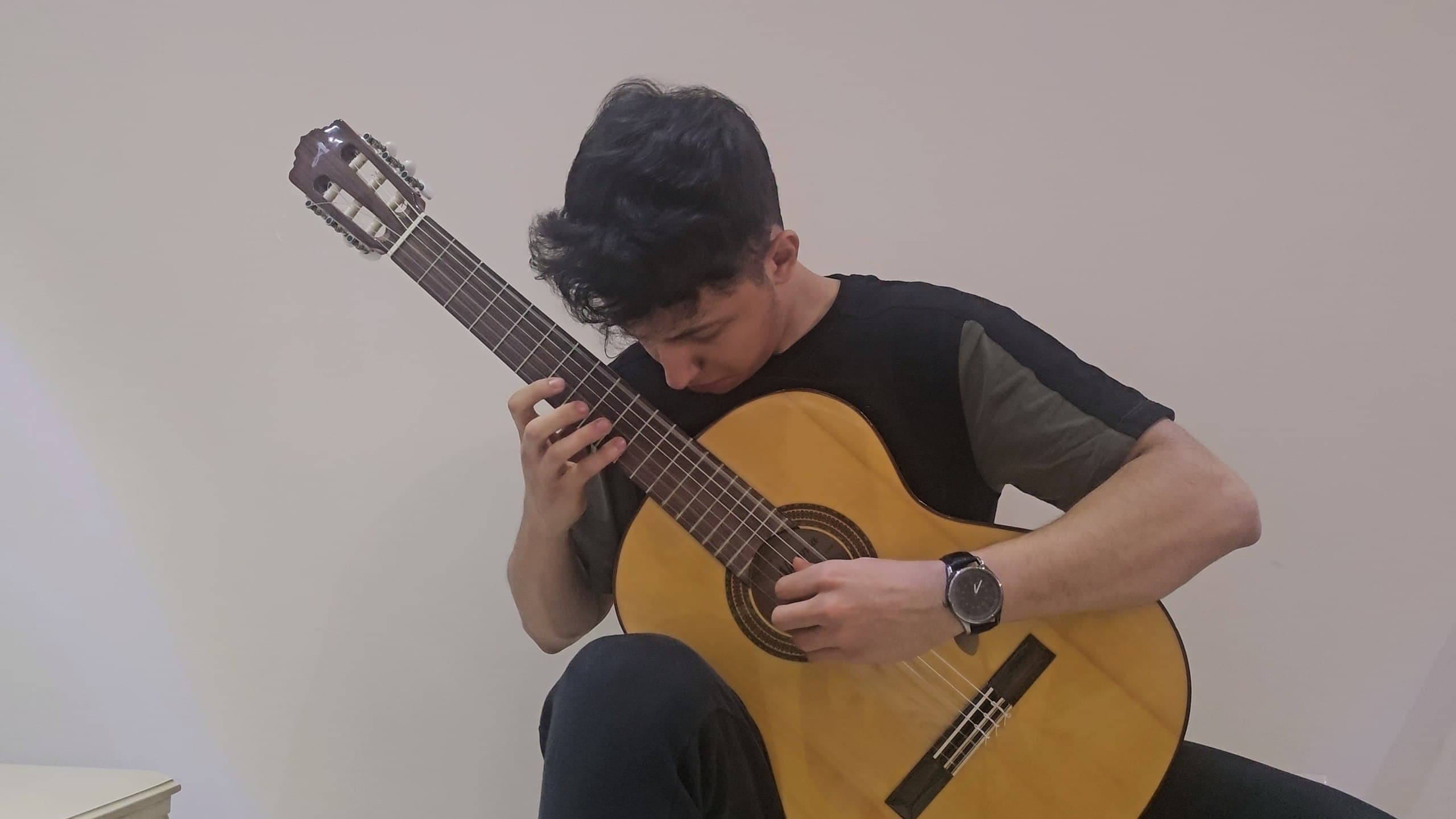
A note has an attack, evolving middle, and decay. A plucked guitar produces a rapid transient and loses energy differently across partials; a bowed string can continually feed the vibration; a piano hammer creates a complex attack that cannot be reconstructed from a steady spectrum alone. Contact point, nail shape, bow position, breath pressure, articulation, and mute all reshape the envelope. Practicing tone means controlling both spectral balance and the micro-timing of onset and release.
Resonance, instruments, and common myths
A resonant system responds strongly near particular frequencies and stores energy temporarily. The guitar body couples string vibration to air far more effectively than the string alone; the vocal tract filters energy from the vocal folds; an instrument body emphasizes some regions and suppresses others. Resonance does not mean every matching object will ring dramatically, nor does it create extra energy. Coupling strength, damping, duration, distance, and frequency alignment determine the result.
Intervals, tuning, and beats
When nearby frequencies interact, periodic reinforcement and cancellation create beats. Players use beats to refine unisons and some intervals, while ensembles adjust pitch according to harmony, register, and instrument. Just intonation offers pure ratios in specific contexts; equal temperament divides the octave evenly to make all keys usable, slightly compromising many intervals. A tuner is a reference, not the final ear. Good intonation is relational and changes with musical function.
Room acoustics and recording decisions
Direct sound reaches the listener first; reflections arrive later and combine into early reflection patterns and reverberation. Too little reflection can make an acoustic instrument feel exposed; too much obscures articulation and rhythm. Low-frequency room modes create uneven bass, while hard parallel surfaces can produce flutter echo. Before buying equipment, change performer and microphone position, add distance from boundaries, and test with claps, speech, scales, and recorded playback. A room is part of the instrument presented to the microphone.
Use science to protect and deepen hearing
Hearing risk depends on both level and duration. Practice breaks, reasonable monitoring levels, distance from loud sources, and appropriate hearing protection matter more than enduring discomfort. Acoustic knowledge also sharpens artistry: compare attacks at different contact points, map resonance by register, listen for beats, and record the same phrase in several positions. The aim is not to replace aesthetic judgment with numbers, but to ask better questions and repeat experiments reliably.
Sources & further reading
Related reading